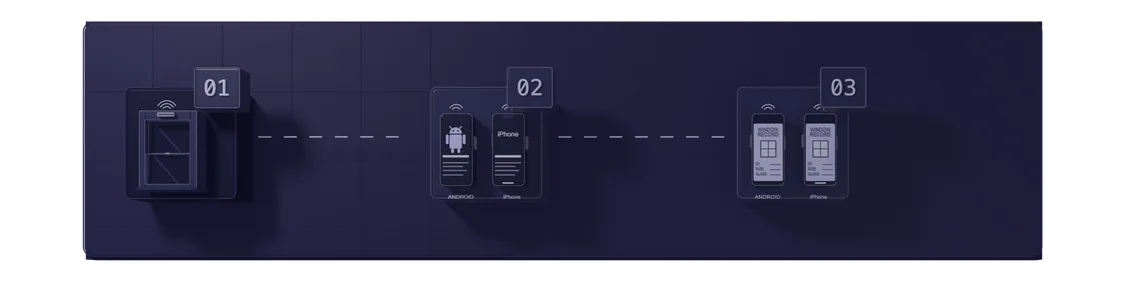
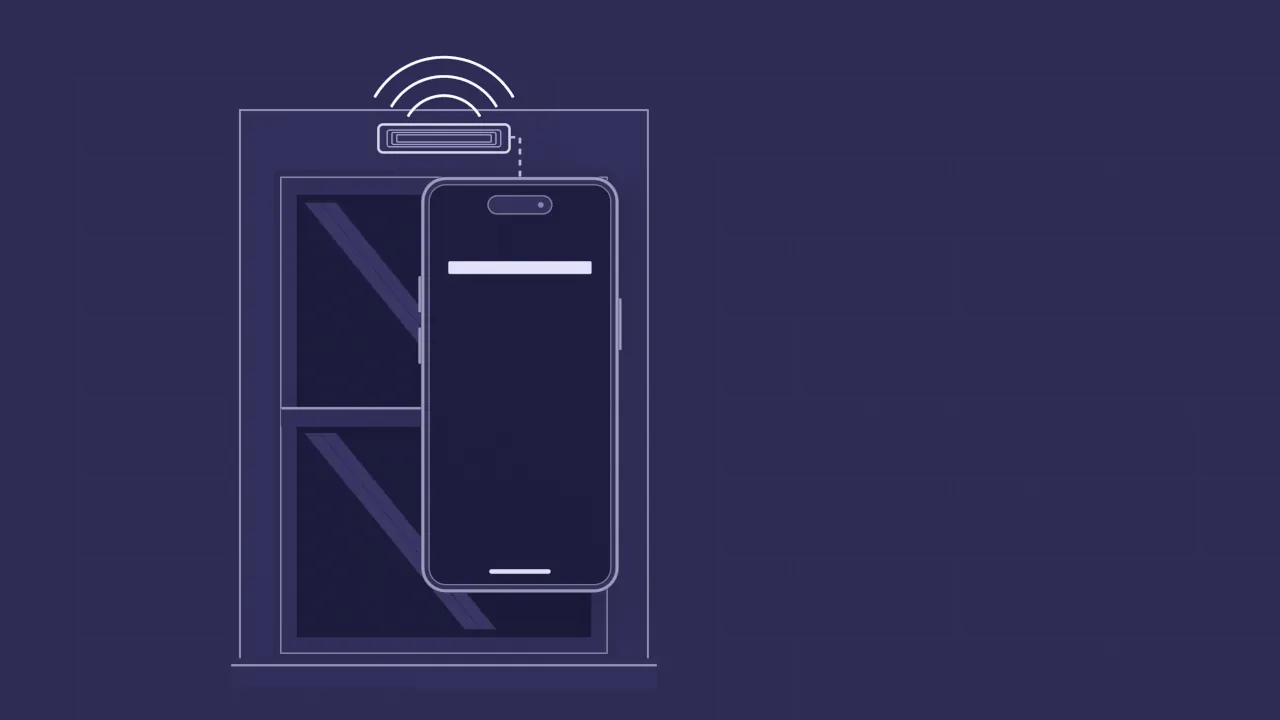
The full record stays on the fixture. Any standard smartphone reads it.
Wise Windows places a on each window, door, or skylight, either embedded in the frame during production or applied in place of the existing identification sticker. The chip carries the fixture’s record and has no power source. A tap from any standard smartphone reads it.
A small chip with no battery. The reading phone’s field powers it for the moment of the read, so there is nothing on the fixture to charge or replace.
01Chip embedded or applied in place of the sticker
02Any standard smartphone taps it
03The full record, on the phone
01
Application methods.
The chip is applied in one of two ways. Both carry the same record, and both read the same way. Every unit carries its own chip and its own unique identifier.
Embedded
In the frame at the factory.
The chip is placed inside the frame during production and written from the production record for that unit.
No visible hardware on the finished fixture
Sits inside the frame material, away from surface wear
Written on the line as part of the production sequence
Adhesive retrofit
In place of the identification sticker.
An adhesive tag is applied in place of the existing identification sticker, with no change to the frame.
No change to the frame or the production tooling
Applies to fixtures already in service as well as new units
Likely the more common case in practice
02
Data Specifications
The fields below are a suggested schema. Each client defines its own set within the same limit.
Manufacturer and model
Specifications: dimensions, frame, glazing
Production batch and date
Certification and rating references
Warranty terms
Installation details
Service contact
A serial number written to each chip, so every fixture carries its own record rather than one record per model.
The chip stores . In plain text that is roughly 150 words, about two short paragraphs, which is enough for the identification and compliance fields above.
The chip holds 888 bytes. In plain text that is about 888 characters, roughly 150 words.
Data can be sourced directly from the manufacturer’s SCADA systems to sync with the batch number of the item, enabling a seamless factory workflow and 100% accuracy.
Sample record (fictitious manufacturer, 782 bytes)
Zephyrquill Fenestration Co. is a fictitious manufacturer. All values are invented for illustration. Edit the text to see how much of the chip a record uses.
Unit ID: ZQF-DH400-2026-00731
Manufacturer: Zephyrquill Fenestration Co.
Plant: P2, Line 4
Product: Series 400 double-hung window
Model: DH-400-3050
Batch: B26-0418-07
Produced: 2026-04-18
Size: 36 x 60 in
Rough opening: 36.5 x 60.5 in
Frame: Vinyl, white, welded corners
Glazing: Dual pane, low-e, argon fill
Spacer: Warm edge
U-factor: 0.27
Solar heat gain: 0.24
Visible transmittance: 0.51
Air leakage: 0.1 cfm/sq ft
Certification ref: CERT-88213-DH400
Rating label ref: RL-2026-4471
Warranty: Limited lifetime, frame and glass; 20 yr seal
Warranty start: Installation date
Installed: 2026-06-02
Installer: Bramblewick Install Co., crew 3
Site: Residential, second floor, north elevation
Service: 800-555-0142, service@zephyrquill.example
Note: Sash lock replacement part SL-400W
03
The tap.
Hold any standard smartphone to the top of the frame, or to the tag where it replaced the identification sticker.
The phone reads the chip at .
The record opens on the phone.
No proprietary scanner. No internet connection. The phone already in the pocket of the installer, the inspector, or the service technician is the reader.
Reads take place within a few centimeters. The chip cannot be read from across a room, which is why the phone is held to the frame.
04
Designed to outlast the label.
A printed label is exposed to sun, weather, cleaning, and handling, and it fails long before the fixture does. The chip is a passive component with no power source and nothing to maintain, and it is designed to remain readable for the service life of the fixture.
Because the record is stored on the chip itself, it stays with the fixture through changes of ownership and service provider, and it needs no account, server, or subscription to remain readable. Preliminary material and environmental testing under the patent work has tested it to endure extreme environments.
Questions about integration or technical evaluation? Contact Wise Windows.